Most guides to buying Texas land tell you the same thing about mineral rights: find out if they're severed from the surface, because if they are, you don't want to be surprised by a lease crew and a drilling rig showing up on your pasture in twenty years. That advice is written for oil and gas country, and there's a lot of Texas where it applies exactly as written.
Llano County isn't that county. The mineral history here isn't petroleum. It's stone.
A county built on granite, not oil
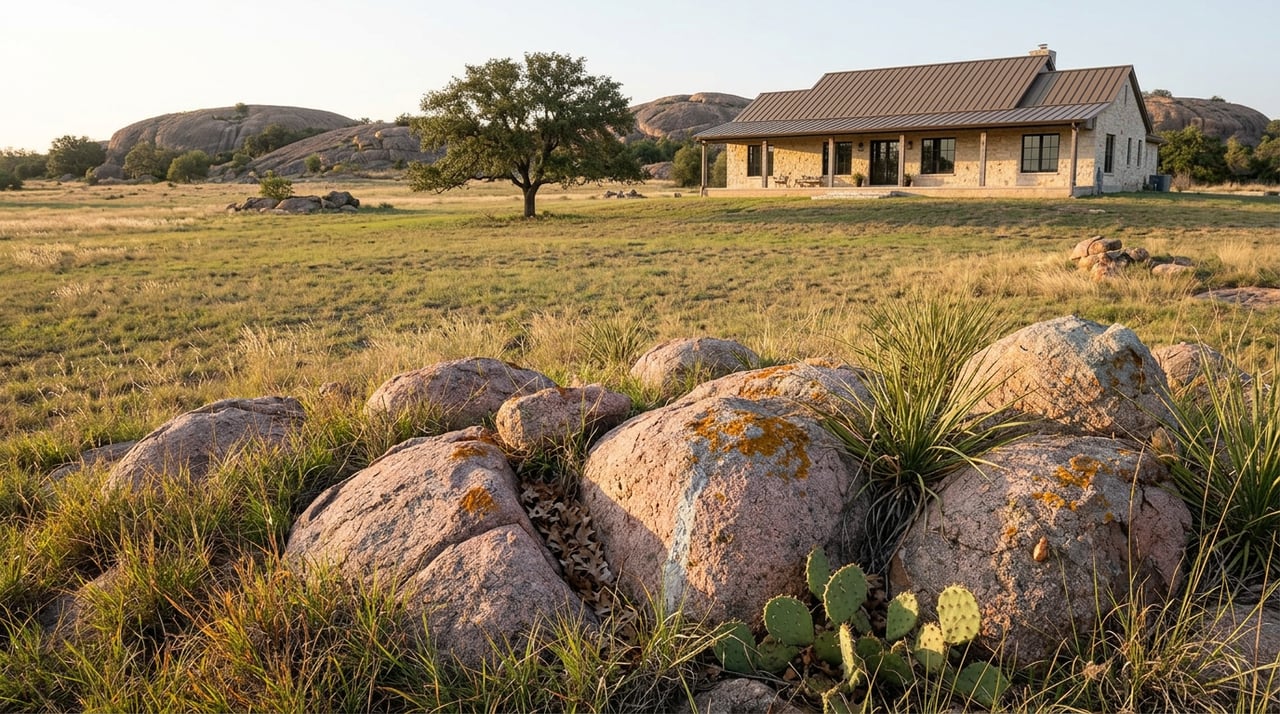
Llano County sits on some of the oldest exposed rock in Texas, and people have been quarrying it since before the county had paved roads to haul it out. The first granite quarry opened in 1888 on the Llano River, and when the railroad reached the area in 1892, demand for the stone took off. An Italian immigrant named Vincenzo Fantozzi Petrick came to Llano County, opened his own quarry, and the granite he pulled out of the ground went into the Texas State Capitol, buildings at the University of Texas at Austin, and a federal building in Kansas City. Work at Petrick's quarry slowed once labor and materials shifted toward the effort to complete Buchanan Dam, but the industry had already made its mark on the county's deed records, which is the part that matters to you as a buyer today.
That history is why "mineral rights" in an older Llano County deed doesn't automatically mean oil, gas, or royalty checks. It can mean building stone. A reservation written decades ago by a quarry operator, a landholding company, or an estate connected to that era's granite trade can still be sitting in your title chain, and it behaves differently than an oil and gas reservation does.
What a severed reservation actually holds
In Texas, the mineral estate and the surface estate can be owned separately, and when they are, the surface owner doesn't automatically control what happens underneath their own boundary lines. Llano County's appraisal records even carry mineral interests as their own separate property type, distinct from the surface account, which tells you how routine this separation is here.
The tricky part isn't finding out that a reservation exists. County records make that visible enough if you know to look. The tricky part is figuring out who actually holds it. A mineral reservation can remain with a prior owner, a trust, an estate, or a company for years after the original transaction, and in Llano County's case, some of those companies were granite outfits that operated a century ago and haven't existed in any functional sense for generations. You can confirm a reservation is real without ever finding a living, answerable party on the other end of it.
Why that changes the actual risk
In an oil and gas county, a severed mineral estate is mostly a financial question. Someone else might get paid if a well goes in, and you negotiate around that. In Llano County, an old granite reservation rarely produces an income stream for anybody. What it can produce is a legal right for someone else to access, quarry, or haul stone across land you thought was entirely yours.
The real exposure in a Llano County granite reservation usually isn't lost royalty money. It's lost control of your own surface.
That's the reframe worth sitting with before you write an offer. You're not protecting a revenue stream you'll never see. You're protecting your ability to build a barn, run a fence line, or plant an orchard exactly where you planned, without a decades-old paper right complicating the picture.
Where to actually look before your option period ends
Two places in Llano County are worth checking directly, and neither requires waiting on a title company to get back to you.
Llano Central Appraisal District, at llanocad.net, keeps mineral interests as a distinct property record separate from the surface account for a given tract. Pulling that record tells you whether a mineral interest is currently carried apart from the land itself. The Llano County Clerk's office holds the deed index that shows how that separation happened and when, going back through the chain of title. Because reservations can travel through prior owners, trusts, or dissolved companies, it's worth searching earlier names in the chain rather than stopping at the current surface owner. The person who reserved the minerals a hundred years ago is rarely the same name showing up on this year's tax roll.
If your title commitment doesn't flag anything unusual, that's a good sign, but it isn't the same as confirming there's no old reservation buried further back than the commitment's search period reaches. Ask your title company directly how far back their search went on this particular tract, especially on land that's been in the same family or the same larger holding for multiple generations.
The realistic ask: a surface waiver, not a clean sweep
If you do find that minerals were reserved and never conveyed back, chasing full mineral ownership is usually not a practical goal, and it isn't necessary to protect what you actually care about. The more realistic and more common request is a surface waiver, an agreement from whoever holds the mineral interest that they won't exercise rights to enter, drill, or quarry on the surface. That single document can resolve the practical concern, which is protecting how you use the land, without requiring you to track down and buy out a mineral interest that may be scattered across heirs or long-dissolved entities.
Why the survey matters as much as the title work
Older Llano County ranch tracts were often described using metes and bounds, the old system of describing boundaries by distances and directions from physical markers rather than a straightforward lot and block. That kind of description ages unevenly. Fence lines shift. Markers disappear. And on land with any connection to the county's quarrying history, a survey can also turn up something a title commitment never will: an old quarry pit, a cut bank, or an access road that was never part of anyone's memory but is very much part of the physical property.
Llano Surveying and Mapping LLC, operating locally since 1972 out of an office on the north side of the courthouse square in Llano, is the kind of firm built for exactly this work, tracts with a long history and legal descriptions that predate GPS coordinates. A current survey paired with a careful title search is the combination that actually protects you here, not either one alone.
Questions worth asking before you're past the option period
- Does the mineral reservation on this tract specifically mention stone, granite, or quarry rights, or is it written broadly enough to cover anything underground
- Who held the mineral estate before the current surface owner, and how far back does that chain go
- Has anyone associated with the mineral interest attempted to access, quarry, or survey the property in living memory
- Does a current survey show any old quarry scars, pits, or access cuts that aren't mentioned in the property description
- If minerals were reserved and not conveyed, is a surface waiver available, and who would need to sign it
None of these questions require a geologist. They require someone willing to read the deed chain past the current owner and ask the county the right question the first time.
Land with this kind of layered history is common across Llano County, and it isn't a reason to walk away from a tract you love. It's a reason to do the reading before closing day instead of after. Our team has spent years working land deals across the Hill Country, including large acreage transactions in Llano County itself, and the pattern holds true on nearly every tract with real history behind it: the properties worth owning are usually worth the extra week of due diligence.
If you're looking at land in Llano County and want a second set of eyes on what a deed, a survey, or a mineral record is actually telling you, Reata Ranch Realty works this ground regularly and can help you ask the right questions before you're locked into an option period. Reach out and let's talk through the specific tract you have in mind.