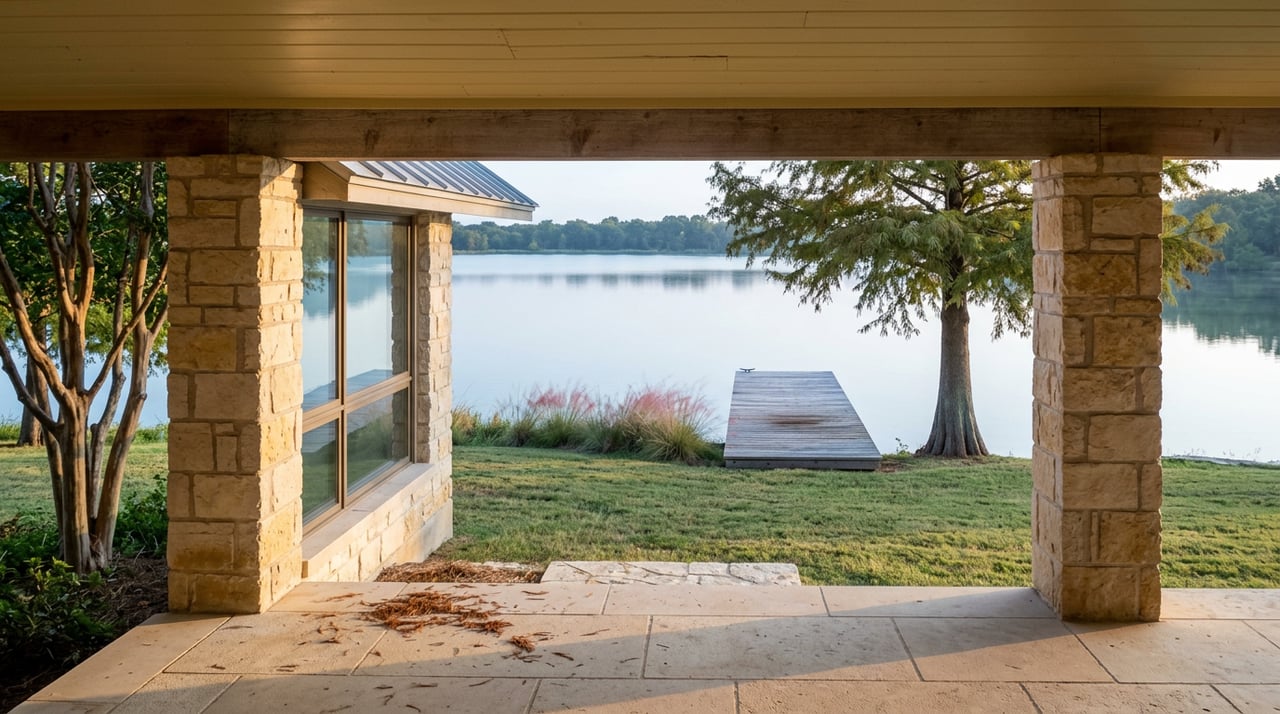
What exactly do you own when you buy fifteen acres on the bank of the Llano River?
Most buyers assume the answer is simple: the land, the trees, and the water running past it, all the way to the far bank if the deed says so. In Texas, that assumption is wrong more often than buyers expect, and the gap between what people think they're purchasing and what the law actually grants them shows up nowhere more clearly than in the price difference between Llano County's two big waterfront categories. Active listings on the market right now show riverfront acreage in Llano County averaging around $988,000, while lakefront acreage on Lake LBJ averages closer to $3 million. That is not a small spread, and it is not explained by acreage or scenery. It is explained by who actually controls the water.
The Price Gap Nobody Explains
Realtors will tell you lakefront costs more because people want boats and swimming and a dock. That's true as far as it goes, but it skips the more interesting mechanism underneath. Both bodies of water sit in the same county, both are fed by the same river system, and both offer granite outcroppings, live oaks, and genuinely beautiful Hill Country scenery. The Llano River even has a case for being the more dramatic of the two, with clear water running over exposed granite bedrock in places like the shallow stretch locals call the Slab near Kingsland.
What separates them is control. Lake LBJ is a piece of engineered infrastructure that happens to be beautiful. The Llano River is a wild system that happens to run past private land. Those are two very different things to buy into, and the price reflects it.
A Lake Built to Stay Nearly Level
Lake LBJ is managed by the Lower Colorado River Authority, a public utility formed in 1934 that operates Wirtz Dam and treats the lake as what engineers call a pass-through reservoir. Water comes in from upstream, water goes out downstream, and the surface elevation stays close to constant year-round, generally near 824.8 feet above mean sea level according to the federal gauge near Marble Falls, which recorded 824.83 feet as of July 23, 2026. That reading is not unusual. It is close to what the lake has held for years, and it is part of the reason lenders and appraisers treat Lake LBJ waterfront as a stable, bankable asset rather than a moving target.
The lake covers about 6,432 acres, stretches roughly 21 miles, and holds about 200 miles of shoreline, reaching close to 90 feet deep near Wirtz Dam. Every dock, boathouse, and shoreline structure on that shoreline requires an LCRA permit, and when you buy a lakefront home, you are also buying whatever permit history comes with it. Confirming that an existing dock permit will transfer at closing is not a formality. It is the difference between owning a functioning amenity and owning a structure the LCRA can require you to remove.
That is what the lakefront premium is actually paying for: a shoreline that remains nearly as steady in ten years as it does today, managed by an agency whose entire purpose is to keep it that way.
The River Doesn't Work That Way
Texas treats rivers differently, and the difference is written into more than a century of state law. The Texas Parks and Wildlife Department explains that a stream in Texas is legally "navigable" if it can serve as a route for trade and travel in its natural state, or if it simply averages 30 feet of width from its mouth upstream, measured bank to bank. Long stretches of the Llano River meet one or both tests.
What that means in practice is blunt. A landowner can hold a deed running to the center of the channel and still have no right to stop a stranger from wading, fishing, floating, or camping within the streambed and, to a limited extent, the banks. A 1935 Texas Supreme Court case put it plainly:
"Hunting, camping, and fishing are reasonable uses of the navigable waters and shore line."
That case, Diversion Lake Club v. Heath, also established something buyers rarely anticipate: the public doesn't need to cross your land to reach a navigable stretch of river. If a public road crosses the water anywhere along its length, anglers and boaters can enter from that bridge and travel the navigable segment from there, without ever setting foot on your property. Owning both banks upstream and downstream of a public crossing does not make that stretch private.
A 1929 law known as the Small Bill complicated things further. It let some landowners hold formal title to sections of streambed, mostly so they could collect mineral royalties underneath it, but it specifically preserved the public's right to use the water above that streambed for fishing, boating, and similar activity. So a buyer can end up holding a legitimate deed to riverbed acreage and still have no legal ability to fence out the public.
None of this means river frontage is a bad purchase. It means the privacy a buyer imagines is often not the privacy the law provides, and confirming a specific segment's navigability status before closing matters more than most other line items in a Hill Country land search.
When the Dam Opens
The river's other risk is more immediate than legal doctrine. On July 16, 2026, the LCRA issued a public notice ahead of scheduled floodgate operations at Wirtz and Starcke Dams, warning that flows below the dams would run fast and water levels downstream would rise higher than usual. The notice specifically told waterfront property owners along the Llano River to alert their neighbors, since unscheduled releases can happen suddenly for hydroelectric or emergency reasons, and debris carried downstream has been known to damage docks, boats, and jet skis.
Compare that to Lake LBJ, where the constant-level design absorbs those same upstream releases before they reach lakefront property. A river buyer is purchasing proximity to a system that can change quickly and with little warning. A lake buyer is purchasing distance from that same volatility, mediated by a dam built specifically to smooth it out.
Same Water Body, Different Rules Depending on the Street
Control on Lake LBJ isn't uniform either, and this is where the comparison gets more useful than a simple lake-versus-river framing. The lake sits across two counties, Llano and Burnet, and the shoreline runs through a mix of incorporated cities, unincorporated county land, and private subdivisions, each layering its own rules on top of the LCRA's baseline permitting.
| Lake LBJ | Llano River | |
|---|---|---|
| Who sets water level | LCRA, constant-level operation | Nature, plus scheduled and emergency dam releases |
| Who can use the water | Permitted dock owners and their guests | The public, on any navigable segment, regardless of bank ownership |
| Where prices run highest | Horseshoe Bay, Applehead Island, Escondido | Historic river towns like Castell |
| Short-term rental oversight | Set by whichever city or HOA governs that stretch of shore | Mostly unincorporated county land, governed by county and state rules |
Horseshoe Bay, Applehead Island, and the Tom Fazio-designed course community of Escondido sit at the top of the lake's price tiers, with custom estates, gated access, and private marinas. Kingsland and Granite Shoals offer a more accessible entry point, with a mix of older fishing cabins and newer builds. Sunrise Beach Village and Highland Haven read quieter, with fewer resort amenities and more full-time residents.
Rental rules split just as unevenly. The Daily Tribune reported that Granite Shoals adopted its own short-term rental registration ordinance in 2021, giving hosts 30 days to register with the city once the rule took effect. Horseshoe Bay and Marble Falls, a few miles up the shoreline, have their own short-term rental rules. Kingsland, being unincorporated Llano County, has no city hall to check with at all, so rental rules there run through county and state law rather than a municipal ordinance. A property that looks ideal for weekend rental income can sit in any one of these jurisdictions, and the difference changes what you're allowed to do with it before you ever list a night.
Before You Write an Offer
A few questions are worth settling before earnest money changes hands, regardless of which side of the county you're looking at:
- Ask whether the specific river segment has been determined navigable in fact or by statute, and get that in writing from a survey or title review rather than assuming based on how the water looks.
- If buying on Lake LBJ, confirm any existing dock or boathouse permit is current and will transfer to you at closing.
- Check whether a homeowners association layers additional restrictions on top of city or county rules, since POA covenants can be stricter than either.
- Confirm which city, if any, has jurisdiction over the parcel before assuming short-term rental income is available.
- If buying near a dam, ask what happened to that street during the 2018 and 2025 flood events, since not every block along the same shoreline flooded the same way.
A Few Direct Questions
Does Lake LBJ's water level ever change? Rarely, and usually only briefly during LCRA flood operations at Wirtz Dam. The lake is officially a pass-through reservoir, but under normal conditions it holds close to its long-term constant level, consistent with the 824.83 foot reading recorded in July 2026.
Do all Lake LBJ communities allow short-term rentals the same way? No. Rules vary by city, by unincorporated county status, and by HOA, sometimes street to street. Confirm the specific parcel's jurisdiction before assuming rental income is part of the deal.
Whether the right fit is a permitted dock on Lake LBJ or land along a stretch of the Llano that still runs wild, the details that actually determine ownership rarely show up in a listing description. Michele Smith and the team at Reata Ranch Realty spend their time in Llano County confirming exactly this kind of thing before a client ever makes an offer. If you're weighing lake against river, reach out and let's look at the specific parcel together.
This article is general information, not legal, tax or financial advice. Consult a qualified professional about your situation.